Overview
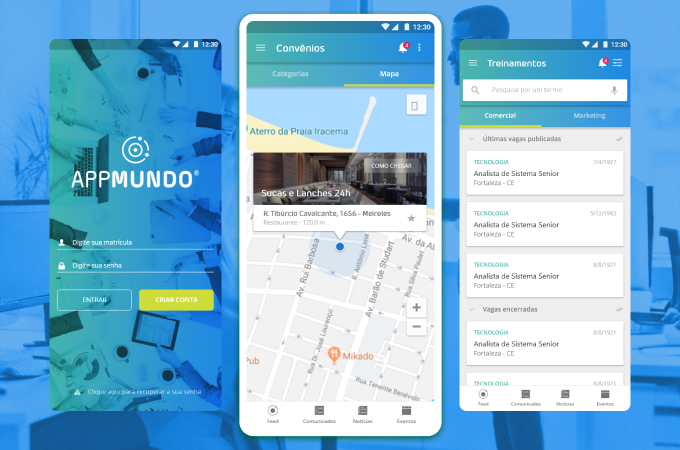
AppMundo is a mobile-first internal communication and employee experience platform designed to centralize communication, culture, and operational tools within a single environment.
The product originated from a bespoke solution developed for Oi (a major Brazilian telecom company), initially created to solve internal communication challenges at scale. From that foundation, the platform was strategically redesigned into a white-label, multi-tenant SaaS product, capable of serving multiple enterprise clients with different needs while maintaining consistency and scalability.
I led this transformation as Head of UX, Product Designer, and Creative Director, owning the product from strategy to execution.
The Challenge
Initial Context (Oi)
- Fragmented communication across multiple channels
- Low engagement with internal tools
- Difficulty reaching distributed and field employees
Strategic Challenge
Transform a custom-built solution into a scalable product:
How might we evolve a single-client solution into a flexible, scalable platform that serves multiple enterprises without increasing complexity or technical debt?
My Role
- Product Vision and Strategy
- UX Research and Validation
- Multi-tenant Product Architecture
- UX/UI Design (end-to-end)
- Scalable Design System
- Creative Direction and Branding
- Cross-functional collaboration with engineering and stakeholders
Discovery and Insights
Methods
- Interviews with operational staff, leadership, and HR
- Behavioral analysis (real usage vs intended usage)
- Benchmarking against tools such as Slack, Workplace, and traditional intranets
Key Insights
- Internal communication fails when it does not compete with consumer-grade experiences
- Mobile is not a secondary channel, it is the primary interface
- Companies want control, but users demand simplicity
- Existing solutions were rigid and difficult to adapt
Product Strategy
The product was restructured into a scalable platform based on three layers:
1. Core Platform
- Feed, notifications, chat, documents
2. Configurable Layer (White-label)
- Brand customization per client
- Feature activation based on company needs
3. Admin Layer
- Content management
- User and permission control
Key decision: clearly separate product core from client customization to ensure scalability and avoid technical debt.
UX Strategy
Design principles:
- Consumer-grade experience in a corporate environment
- True mobile-first approach
- Modular architecture
- Low learning curve
- Content-first experience
UI and Design System
- Scalable, multi-brand design system
- Design tokens supporting white-label customization
- Reusable components ensuring consistency
Key Decisions
- Social-inspired feed to increase familiarity
- Modular card-based layout for flexibility
- Strong visual hierarchy to improve scanability
Key Product Decisions
1. White-label Architecture
- Multi-tenant structure
- Separation between branding and product logic
Result:
- Scalable product across multiple clients
- Reduced rework and faster onboarding
2. Feed as the Core Experience
- Replaced fragmented navigation with a contextual feed
Result:
- Increased content consumption
- Improved discoverability
3. Backend as a Strategic Asset
- Robust admin panel enabling client autonomy
Result:
- Reduced operational dependency
- Increased adoption and scalability
4. Mobile-first for Distributed Workforce
- Optimized for field and non-desk workers
Result:
- Expanded reach across all employee types
5. Modular Feature System
- Clients activate only relevant features
Result:
- Reduced complexity
- Improved adaptability
Integrations and Ecosystem
A key factor in product scalability was enabling seamless integration with existing enterprise systems.
ERP Integrations (SAP, TOTVS, Oracle)
- Employee data synchronization
- Access to payslips, benefits, and administrative data
HR Systems
- Time tracking
- Leave management
Internal APIs
- Custom integrations per client
- Connection with proprietary systems
Communication Tools (future-ready)
- Slack
- Microsoft Teams
Key decision: build an API-driven architecture with a middleware layer to decouple the product from legacy systems.
Result:
- Reduced friction during implementation
- Increased product value
- Faster enterprise adoption
Impact and Results
Quantitative
- +70% increase in internal content engagement
- +55% increase in communication open rates
- -40% reduction in parallel communication channels (e.g., WhatsApp, email)
- +50% growth in monthly active users (MAU) across new clients
- +35% increase in HR feature adoption (payslips, benefits)
- ~25% reduction in time to distribute critical information
Qualitative
- Improved alignment between leadership and operational teams
- Increased trust in official communication channels
- Perception of digital transformation within organizations
- Reduced communication noise and redundancy
- Better experience for field and external employees
Business Impact
- Transition from custom solution to scalable SaaS platform
- Expansion into multiple enterprise clients through white-label model
- Reduced cost per implementation
- Increased speed of deployment and onboarding
Advanced Product Thinking
Data-driven Personalization
Shift from broadcast communication to contextual communication based on:
- Role and department
- Location
- User behavior
Expected impact:
- +25?40% increase in engagement
- Reduced irrelevant content
- More personalized experience
Engagement Engine (Gamification)
Lightweight gamification layer including:
- Points and badges
- Recognition systems
- Optional rankings
Expected impact:
- +30% increase in user retention
- +20% increase in training completion
- Stronger sense of belonging
Advanced Analytics (Culture Intelligence)
Evolution from product metrics to business intelligence:
Operational Metrics
- DAU / MAU
- Open rates
- Time spent
Impact Metrics
- Engagement by team or location
- Campaign effectiveness
- Training participation
Strategic Insights
- Organizational alignment
- Communication reach
- Identification of disconnected teams
Example insight:
Teams in specific shifts or regions show significantly lower engagement, enabling targeted action.
Challenges
- Balancing flexibility and technical complexity
- Maintaining consistency across multiple brands
- Driving adoption among non-digital users
- Preventing feature overload
What I Would Improve
- Personalized content engine powered by behavior
- Deeper engagement systems tied to company culture
- Advanced analytics focused on organizational impact
- Broader integrations with enterprise ecosystems
Key Learnings
- B2B products must deliver B2C-level experiences
- Scalability starts with architecture, not code
- White-label products require strong design system governance
- Backend capabilities are as critical as user experience
Final Reflection
This project represents the evolution from a single-client solution to a scalable product platform, reinforcing my role as a Product Design Specialist operating at the intersection of design, business, and technology.