Overview
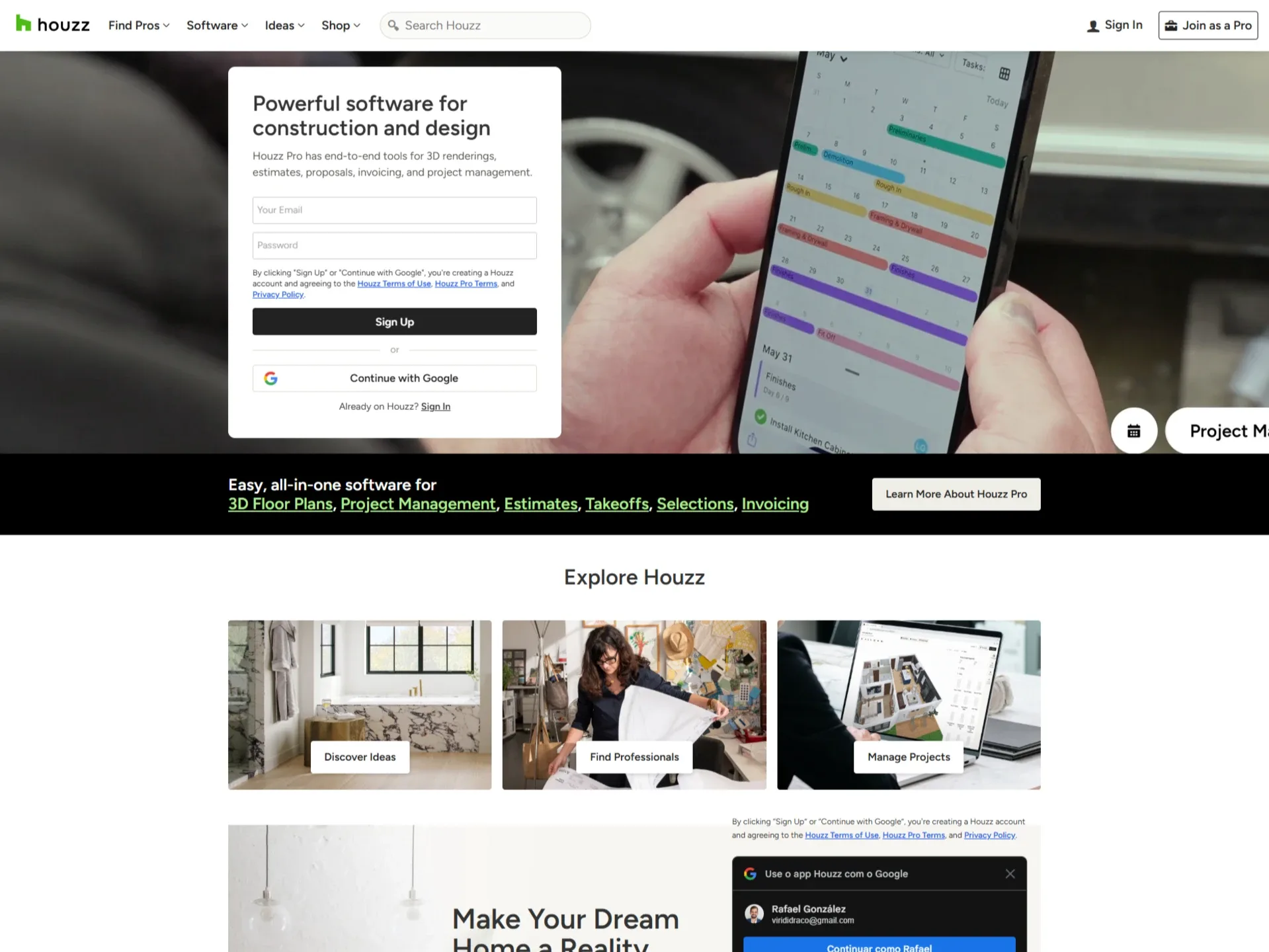
Houzz is a global platform that connects homeowners, design professionals, and brands in a unified ecosystem focused on home renovation and interior design.
Operating as a multi-sided marketplace, it combines:
- inspiration discovery
- product commerce
- professional hiring
I was invited as a Product Designer, Art Director, and Researcher to collaborate with an external team as a consultant, contributing to improving the user experience across key stages of the journey.
Context
Despite its strong value proposition, Houzz presents a complex challenge:
How do you seamlessly connect emotional inspiration with rational decision-making in a single experience?
The platform successfully attracts users through visual inspiration, but struggles to efficiently guide them toward conversion actions such as purchasing products or hiring professionals.
Problem Statement
Users experience friction when transitioning from inspiration to action.
Key issues identified:
- Overwhelming content without clear next steps
- Weak connection between saved ideas and actionable options
- Fragmented journey between browsing, buying, and hiring
- Low guidance in decision-making moments
Research Approach
To deeply understand the problem, we combined qualitative and heuristic methods:
Heuristic Evaluation (Nielsen)
- Recognition over recall: users struggle to reconnect saved ideas with actionable options
- User control and freedom: difficult to navigate between inspiration and execution stages
- Match between system and real world: lack of contextual guidance for real-life decisions
Behavioral Analysis
Drop-off observed between:
- saving inspiration
- taking action (buy / hire)
Insight:
Users engage emotionally, but hesitate when forced into decision-making without support.
Benchmark Analysis
| Platform | Strength | Gap |
|---|---|---|
| Discovery | No execution layer | |
| Wayfair | Commerce | Low inspiration context |
| Angi | Services | Limited emotional engagement |
| Houzz | End-to-end journey | Fragmented transitions |
Strategic insight:
Houzz?s competitive advantage lies in integration, but its biggest challenge is orchestrating that complexity.
Key Insights
- Inspiration is emotional, decision-making is rational
- Users need guidance, not just content
- Context is critical to reduce cognitive load
- The journey must feel continuous, not segmented
Solution Strategy
We focused on reducing friction between inspiration and action by designing a more guided and contextual experience.
Core Principles
- Connect inspiration directly to actionable steps
- Reduce cognitive load through contextual recommendations
- Improve clarity in user progression
- Support decision-making moments
Design Solutions
Contextual Action Layer
- Products and professionals surfaced directly within inspiration content
- Reduced need to leave the discovery flow
Guided Journey
-
Introduced clearer transitions from:
- Save ? Explore ? Act
- Reduced ambiguity in next steps
Enhanced Content Hierarchy
- Improved scannability
- Better prioritization of relevant information
- Cleaner visual structure
Decision Support
-
Added contextual cues:
- recommendations
- related products
- professional suggestions
Shift from passive browsing to assisted decision-making.
Role and Contributions
- Product strategy alignment
- UX and interaction design
- Art direction and visual consistency
- Research synthesis and insight generation
- Collaboration with cross-functional teams
Validation
- High-fidelity prototypes for flow validation
- Internal reviews with product and design teams
- Rapid feedback cycles
Impact
Qualitative Results
- Reduced friction between inspiration and action
- Increased clarity in user journey
- Improved perceived usability and navigation
- Stronger connection between content and conversion
Expected Business Impact
- Higher conversion potential (products and services)
- Increased engagement across sessions
- Stronger retention through continuous journey
Learnings
Designing for a marketplace like Houzz reinforced a key principle:
A great product does not just inspire. It guides users to act with confidence.
Balancing emotional engagement with functional clarity is essential when designing complex ecosystems.
Final Thought
This project highlights the importance of:
- designing decision flows, not just interfaces
- connecting UX directly to business outcomes
- simplifying complexity without losing value