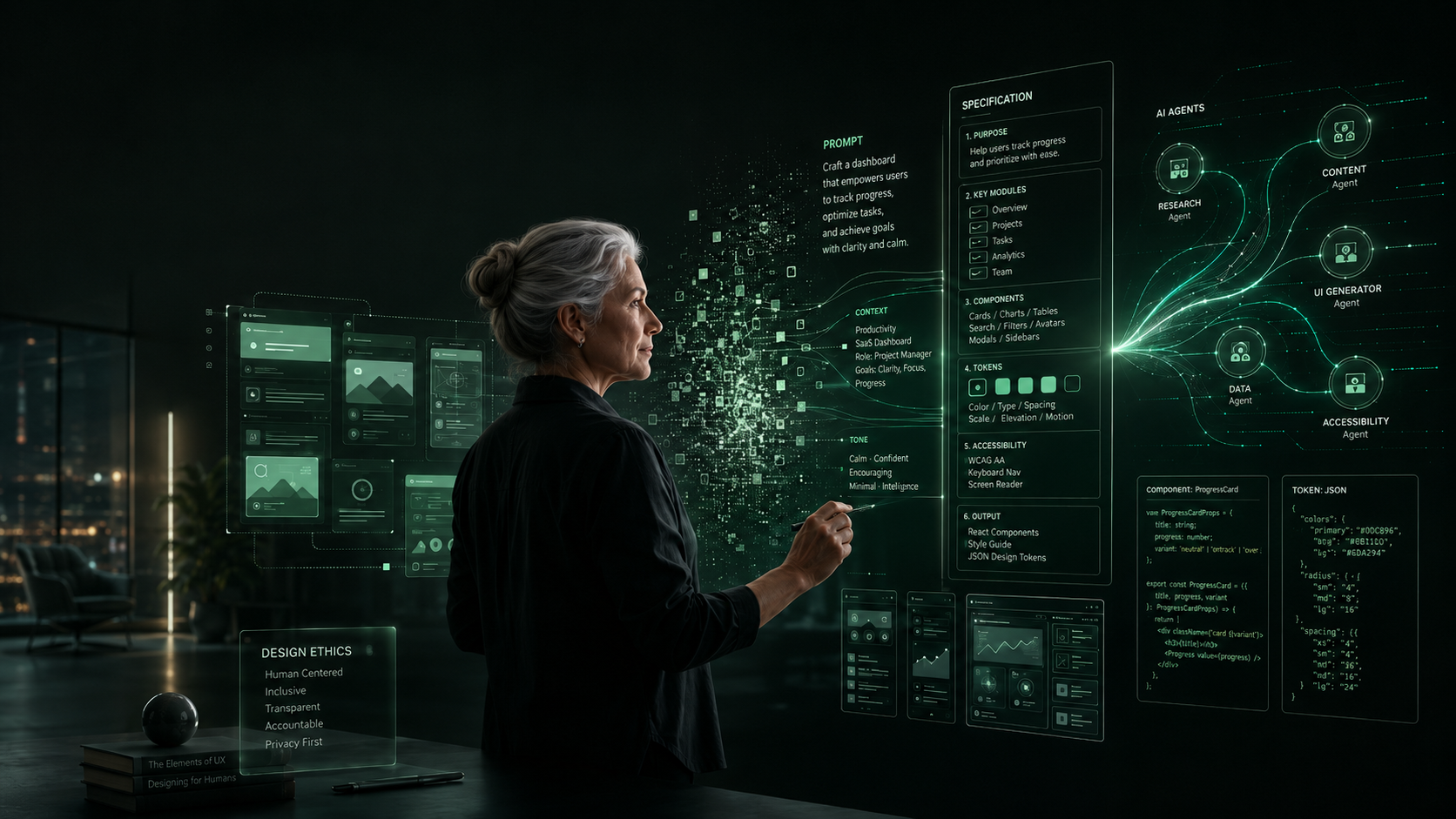
How AI and Spec-Driven Development Are Redefining Design
Introduction: The End of 35,000 Decisions?
The average human makes around 35,000 decisions per day. This figure, drawn from the preface of Hooked by Nir Eyal, serves as a metric for the cognitive load of modern life: we make a decision every two seconds. But in 2026, this statistic is being hacked. Artificial intelligence is no longer merely assisting our choices; it has started making them for us.
Where does the ?digital? end and the ?physical? begin? The fusion is complete. The central problem of design has shifted from ?how to make choice easier? to ?how to orchestrate anticipation.? The era of the pixel-pusher is dead; the era of the systems orchestrator has arrived. In a world of fluid interfaces, the designer no longer draws the destination; they govern intent.
The Vibe Architect: Why Participation Is the New Portfolio
UX is no longer about designing static screens, but about managing Agentic AI. In 2026, interfaces have stopped being passive tools. According to the latest trends, ?pages are becoming teammates?: proactive systems that act, suggest, and evolve in real time. The designer now takes on the role of Vibe Architect, focusing on three structural shifts:
From deterministic interfaces to probabilistic systems: We are moving away from the logic of ?Button A always leads to Screen B? toward systems that calculate the interface most likely to satisfy the user?s intent.
From rigid flows to intent-based behaviors: Design no longer dictates the path; it interprets the goal and generates the journey instantly.
The transition from ?pixels? to ?vibe? and context: When execution is automated, the competitive advantage becomes aesthetic curation and emotional context.
As Tom Krcha aptly put it, ?taste? and ?participation? in the refinement process are the only barriers against commoditization. If AI can generate the artifact, human value lies in the sensitivity to decide which version of reality should be delivered.
Spec-Driven Development: The End of Artifact Sovereignty
The distinction between Deterministic Design and Stochastic Design is what separates the senior professional from the enthusiast in 2026. In traditional design, the artifact ? the Figma file, the prototype ? proved seniority. Today, the artifact is irrelevant as the final deliverable. The new frontier is Spec-Driven Development.
In this paradigm, the ?Specification? ? or Spec ? is not a static document or a PDF; it is a living, machine-readable system of constraints that guides Stochastic Design models. The designer defines the boundaries, ethics, and brand voice; AI generates the variation.
?My biggest personal design tool is looking at what that genre is doing and making it 3 to 5 percent different.?
? Virgil Abloh
This logic of curation and deviation is the soul of modern specification. Clarity in the Spec is what guarantees brand integrity in a sea of synthetic generations. The artifact no longer proves seniority; what matters now is the precision of the guidelines that govern uncertainty.
The Hook Model 2.0: Designing with Uncertainty
Nir Eyal?s cycle ? Trigger, Action, Variable Reward, Investment ? has been remapped for the reality of generative AI. In 2026, the ?uncertainty? of AI outputs is not a bug, but the reward itself.
| Hook Phase | Traditional Approach | AI 2026 Approach |
|---|---|---|
| Trigger | External, such as notifications, or internal, such as emotion. | Predictive: Systems anticipate pain or FOMO before the user even feels it. |
| Action | Conscious effort to navigate. | Intent-based: AI reduces friction to the absolute minimum, generating the solution on demand. |
| Variable Reward | Dynamic content in pre-established feeds. | Micro-personalization: The uncertainty of AI output creates constant, microscopic surprise. |
| Investment | Manual data input or time spent. | Fine-tuning: Investment becomes the continuous refinement of the model through use and project memory. |
In 2026, ?Investment? essentially means training your personal AI. Each interaction is not just a data point being collected, but a fine-tuning adjustment that makes the next ?Action? smoother and the ?Reward? more precise.
The Seniority Crisis: When Skill Becomes a Commodity
The rise of AI has triggered an uncomfortable phenomenon: ?AI has made junior designers look senior,? as Hannah Ahn points out. Tools like memi ? a macOS app that integrates models such as Codex and Claude with project memory, design system context, and handoff to Figma ? have removed the barrier of technical execution.
If we apply Fogg?s B=MAT model ? Behavior = Motivation + Ability + Trigger ? we can see that the Ability variable has been maximized by technology. When anyone can execute with technical perfection through prompts, ?Ability? is no longer a differentiator.
What is left for the human designer? The only remaining levers are Motivation and Ethical Context. The 2026 economy does not pay for the ability to design a button, but for the critical judgment to know whether that button should exist and what psychological impact it will create.
Conclusion: Are You Designing Habits or Addictions?
Revisiting Nir Eyal?s thin line between habit and addiction, 2026 places us at an unprecedented ethical crossroads. With the ability to create instant interfaces and hyper-personalized rewards, the risk of manipulation becomes absolute.
Your superpower no longer lies in the tool you master, but in the responsibility you take for orchestrating human attention. Are we creating products that improve lives, or just infinite dopamine systems that enslave attention?
In a world where AI can instantly create any interface, what is the unique value of your human perspective?

Join the conversation 0
Share your perspective. Every comment is reviewed before publication.
Be the first to share your point of view.